
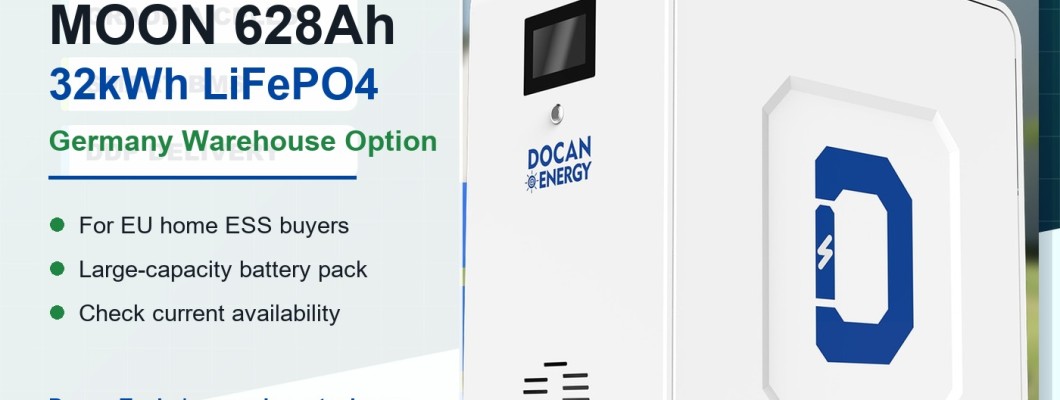
A 32kWh LiFePO4 battery pack is a practical energy storage size for customers who need more capacity than a small rack battery system, but do not need a very large commercial battery cabinet. It is commonly used for solar storage, home backup power, off-grid systems, RV energy projects and small ESS applications.
For many buyers, the main question is not only the battery capacity. They also need to check inverter matching, BMS current, communication protocol, delivery method and whether local warehouse delivery is available.
What does 32kWh mean?
A 32kWh battery pack stores about 32 kilowatt-hours of energy. For a 51.2V system, a 628Ah pack is about 32.15kWh of nominal capacity. The actual usable energy depends on the system settings, inverter efficiency, discharge depth and the load profile.
This size is suitable when the customer wants a larger battery bank in one cabinet-style pack instead of connecting many smaller batteries together.
Common uses for a 32kWh LiFePO4 battery pack
1. Home solar energy storage
A 32kWh LiFePO4 battery pack can store daytime solar power and supply the home at night. It is useful for customers who want to reduce grid dependence or keep important loads running when solar production is low.
2. Backup power for homes and small businesses
For backup systems, battery size should be matched to the customer’s critical loads. A 32kWh pack can support lighting, refrigerators, internet equipment, pumps and selected appliances, depending on power consumption and inverter size.
3. Off-grid cabins and remote solar systems
Off-grid systems need enough battery capacity for cloudy days and night-time loads. A 32kWh pack is often considered for cabins, farms, workshops and remote power systems where stable storage is more important than minimum upfront cost.
4. RV, mobile and temporary power projects
Some RV or mobile energy projects use larger LiFePO4 packs when they need longer runtime, solar charging and inverter power for appliances or tools. Before using a heavy pack in a mobile project, the customer should confirm space, weight, wiring and protection requirements.
5. Small commercial ESS projects
For small commercial backup or solar self-use projects, a 32kWh pack can be part of a modular ESS plan. The final design should check peak load, daily energy use, inverter current, cable size, protection devices and whether more packs will be connected in parallel.
Why choose LiFePO4 chemistry?
LiFePO4 battery packs are widely used in energy storage because they offer stable safety performance, long cycle life and good thermal stability. For solar and ESS customers, LiFePO4 is usually preferred over older lead-acid systems when long-term use, usable capacity and lower maintenance are important.
What should be checked before ordering?
- System voltage: confirm whether your inverter and battery system are 51.2V / 48V nominal.
- Inverter model: share the inverter brand and model so communication and current settings can be checked.
- BMS current: check the continuous current requirement, especially for high-power inverters.
- Communication: confirm CAN / RS485 protocol requirements if inverter communication is needed.
- Parallel connection: confirm cable size, protection devices and BMS settings before connecting multiple packs.
- Delivery condition: confirm address, unloading condition, forklift or liftgate requirement before shipment.
- Warehouse availability: stock and delivery time should be confirmed before payment because local warehouse status can change.
Docan 32kWh battery pack option
Docan can help customers check suitable 32kWh LiFePO4 battery pack options for home ESS, solar storage and off-grid projects. A typical 51.2V 628Ah pack uses 32pcs 314Ah Grade A LiFePO4 cells in a 16S2P configuration, with a smart BMS, touch screen and communication support for compatible inverter systems.
For European customers, Germany / EU warehouse options may be available depending on current stock. Please confirm the latest warehouse status, shipping cost and delivery schedule before ordering.
How to get a faster quotation
To get a more accurate recommendation, please send the battery model you are interested in, quantity, destination country, ZIP code or delivery address, and your inverter brand/model if available.
Contact Jenny from Docan Technology for current 32kWh LiFePO4 battery pack availability, shipping options and system matching support.
8 Comment(s)
A total of 1,768 patients with type 2 diabetes mellitus participated in three double-blind
trials to evaluate the efficacy and safety of NESINA in patients with
inadequate glycemic control on diet and exercise. All three trials had a four week, single-blind, placebo run-in period followed by a 26 week randomized
treatment period. Patients who failed to meet prespecified hyperglycemic goals during the 26 week treatment periods
received glycemic rescue therapy. 8%) were randomized to receive NESINA 12.5 mg, NESINA 25
mg or placebo once daily. Improvements in A1C were
not affected by gender, age or baseline body mass index (BMI).
The mean change in body weight with NESINA was similar to placebo.
8.8%) were randomized to receive NESINA 25 mg alone, pioglitazone 30 mg alone, NESINA 12.5 mg with pioglitazone
30 mg or NESINA 25 mg with pioglitazone 30 mg once daily. Coadministration of NESINA 25 mg with
pioglitazone 30 mg resulted in statistically significant improvements from baseline in A1C and FPG compared
to NESINA 25 mg alone and to pioglitazone 30 mg alone (Table 4).
A total of 3% of patients receiving NESINA 25 mg coadministered with pioglitazone 30 mg, 11% of those receiving NESINA 25 mg alone and 6% of
those receiving pioglitazone 30 mg alone required glycemic rescue.
Improvements in A1C were not affected by gender, age or baseline BMI.
The mean increase in body weight was similar between pioglitazone alone and NESINA when coadministered with pioglitazone.
HCl 1000 mg, 17.3% of patients receiving NESINA 12.5
mg, 22.9% of patients receiving metformin HCl 500 mg, 10.8%
of patients receiving metformin HCl 1000 mg and 38.7% of patients receiving placebo required glycemic
rescue. Improvements in A1C were not affected
by gender, age, race or baseline BMI. The mean decrease in body weight
was similar between metformin alone and NESINA when coadministered with metformin.
I was curious if you ever considered changing the layout of your blog?
Its very well written; I love what youve got to say. But maybe you could a
little more in the way of content so people could
connect with it better. Youve got an awful lot of text for only having 1 or 2 images.
Maybe you could space it out better?
I need to to thank you for this excellent read!!
I absolutely loved every little bit of it. I have you book-marked
to look at new stuff you post…
Bu içerik Diyarbakır escort ilanları konusunda güncel bilgi arayan ziyaretçiler için faydalı ayrıntılar sunuyor.
Enjoyed this — straight to it. Working through the same thing and the framing
was useful. What resonated was that it did not pretend it was easy.
Saving this. Appreciate the effort.
Excellent goods from you, man. I've understand your stuff
previous to and you are just too excellent. I actually like what you've acquired here, really like
what you are stating and the way in which you
say it. You make it enjoyable and you still take care of to keep it smart.
I cant wait to read far more from you. This is actually a terrific website.
Hi there, I enjoy reading all of your article. I wanted to write a little comment to support you.
You made some decent points there. I looked on the internet for additional information about the issue and found most people will
go along with your views on this site.
Leave a Comment